
Two of the most commonly confused coverage types in commercial insurance — and two of the most consequential gaps when a business gets them wrong.
If you've ever shopped for business insurance and wondered whether general liability is "enough," or whether professional liability is just for lawyers and doctors, you're not alone. These policies are frequently misunderstood, often conflated, and routinely undersold to businesses that genuinely need both.
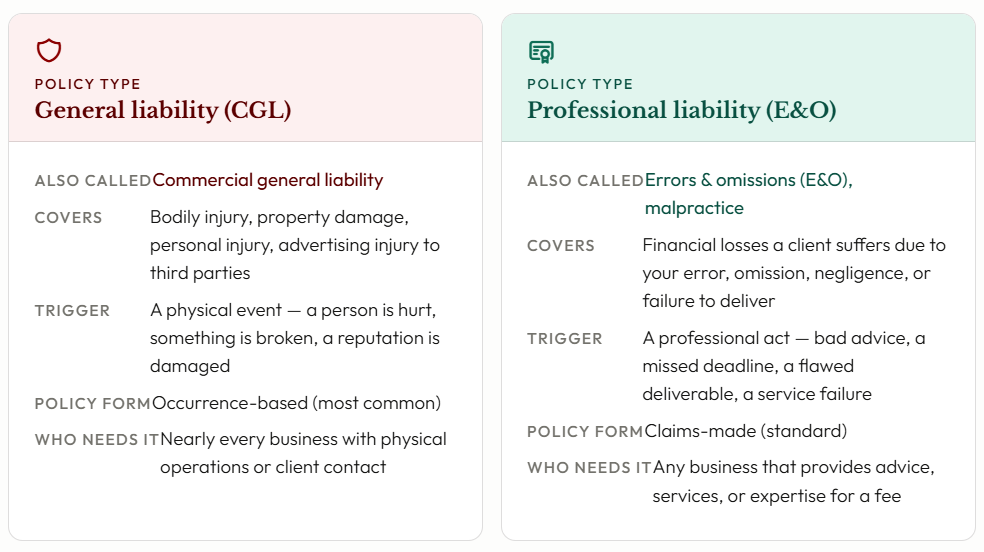
The short version: general liability covers physical harm and property damage your business causes to others. Professional liability covers financial harm caused by the advice, services, or expertise your business provides. They cover entirely different kinds of claims — which is exactly why so many businesses need both.
The policies side by side
The clearest way to understand it: real scenarios
Abstract definitions only go so far. The fastest way to understand the difference is to see where each policy does and doesn't respond.
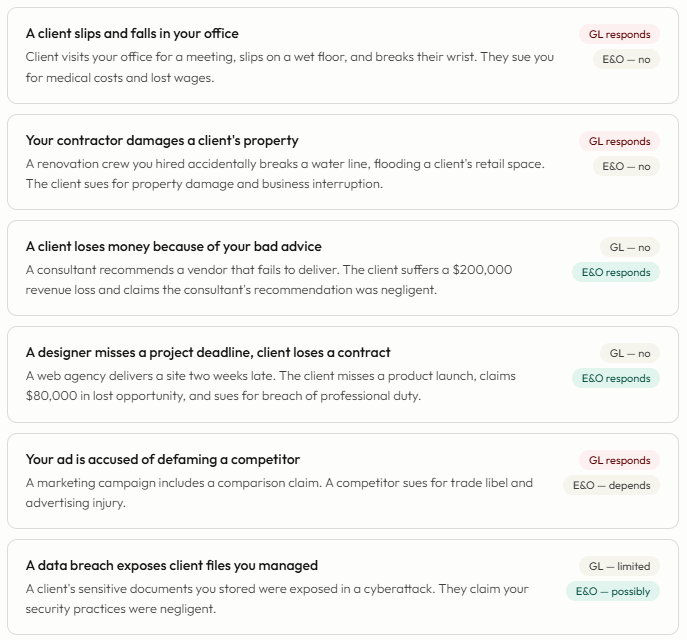
The pattern is consistent: general liability responds to things that happen physically. Professional liability responds to things that happen professionally. A business that only has one is exposed every time a claim falls into the other column.
The claims-made vs. occurrence difference — why it matters
General liability is almost always written on an occurrence basis. This means the policy that was in force when the injury or damage occurred is the one that responds — even if the claim is filed years later. If someone slips in your office in 2024 and files a claim in 2026, your 2024 GL policy responds.
Professional liability works differently. Most E&O policies are written on a claims-made basis, meaning the policy that is in force when the claim is filed is the one that responds — regardless of when the underlying work was done. This creates an important gap to understand: if you let your E&O policy lapse, you lose coverage for past work going back to when that policy began.
This is why claims-made policies include "prior acts" or retroactive date provisions — and why it's critical to maintain continuous professional liability coverage and never let it lapse between carriers without confirming a matching retroactive date on the new policy.
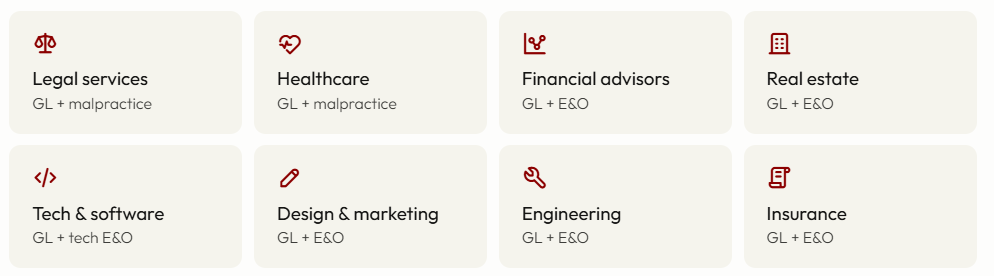
Which industries typically need both
The question "do I need both?" almost always has the same answer for service-oriented businesses: yes. But the industries where professional liability is non-negotiable tend to share one characteristic — clients are paying for expertise, and a failure of that expertise can cause significant financial harm.
Common questions, direct answers
My client's contract requires general liability — does that cover me for everything?
No. Contract requirements for GL are about protecting the client from physical harm and property damage on a project. They don't address professional errors. You may fully satisfy the contract requirement and still be personally exposed for a professional liability claim the same client could file.
I work from home and rarely see clients in person — do I still need GL?
Often yes — but the case for GL shifts depending on your business model. If you sell physical products, have any client-facing events, or ever visit client premises, GL remains important. For a purely digital, advice-based business, professional liability may be the higher priority. Your broker can assess the actual exposure.
Can I just get a business owner's policy (BOP) and call it done?
A BOP bundles GL and commercial property at a favorable price point — it's a strong foundation for many small businesses. But BOPs don't include professional liability. If your work involves any form of advice, consulting, or service delivery, a BOP alone leaves a meaningful gap.
My LLC protects me personally — why do I need E&O?
An LLC limits personal liability for business debts in many situations, but it doesn't protect the business itself from judgments. A large E&O claim can wipe out business assets, affect your ability to operate, and in some circumstances still reach personal assets depending on how the claim is structured. Entity protection and insurance protection serve different functions.
How much does professional liability typically cost?
For small to mid-size service businesses, E&O premiums typically range from $500 to $3,000 annually depending on industry, revenue, claims history, and limits selected. High-risk professions (medical, legal, financial) and larger revenue bases push that range higher. Getting a quote is the only way to know your specific number.
The honest bottom line
If your business has a physical presence, interacts with clients, or could be blamed for hurting someone or damaging something — you need general liability. If your business provides services, advice, or expertise that a client pays for and relies on — you need professional liability. For most service businesses operating in Chicago or anywhere in Illinois, that means both.
The good news is that having both doesn't have to be complicated or prohibitively expensive. A well-structured program can combine them efficiently, with limits appropriate to your revenue, industry, and client relationships. The mistake to avoid is assuming one covers the other — because when a claim comes in, it won't.