
Umbrella Insurance: The Overlooked Shield Every Real Estate Portfolio Needs
You've built a real estate portfolio worth protecting. But most investors don't realize how much of it sits dangerously exposed — until a lawsuit arrives.
You carry landlord insurance on each rental property. You have commercial general liability on your LLCs. Maybe you've even structured ownership entities to separate risk. That's smart. But here's the uncomfortable truth: those underlying policies have limits, and lawsuits — especially in today's legal environment — routinely exceed them.
A personal umbrella or commercial umbrella policy is the layer that sits above all of it, quietly standing guard over everything you've built. For real estate investors, it's not optional coverage. It's a cornerstone.
How the layers actually work
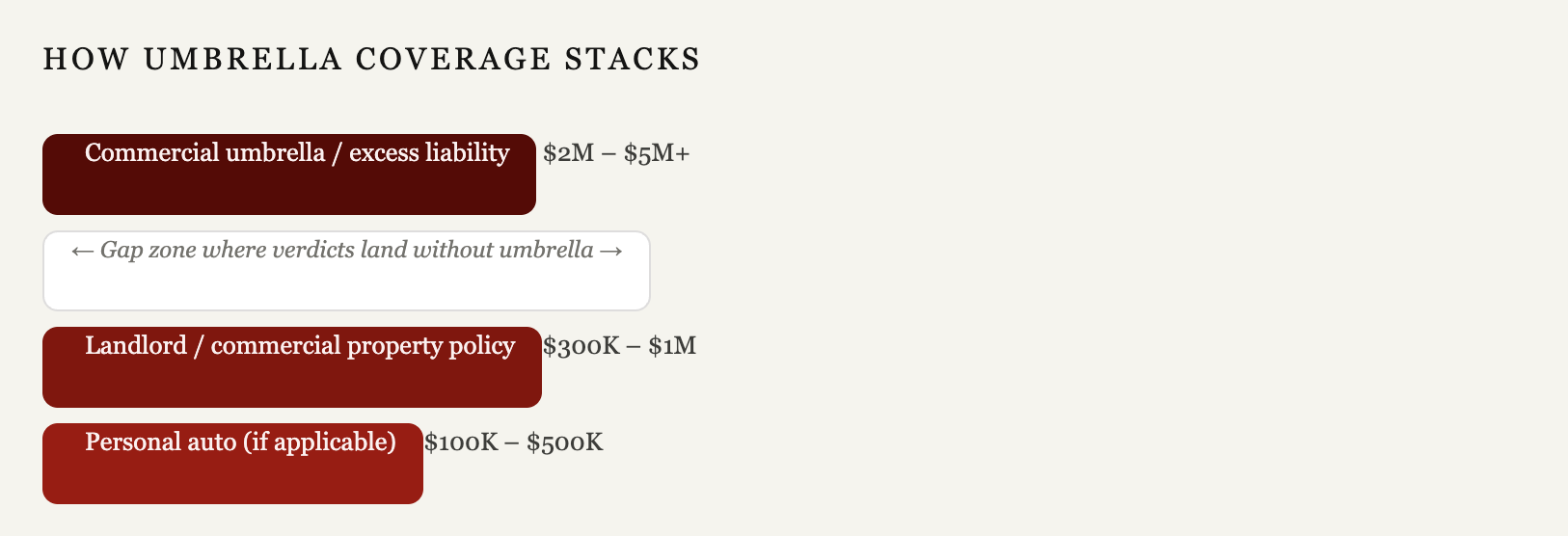
Think of your liability coverage as a stack. Your landlord or commercial property policy is the foundation — it responds first when a claim occurs. But it has a ceiling, typically $300,000 to $1,000,000 per occurrence. If a judgment or settlement exceeds that ceiling, the difference falls to you personally unless there's something sitting above it.
That's the umbrella. It picks up where the underlying policy leaves off and extends your total coverage by $1 million, $2 million, $5 million, or more — often for a fraction of the premium you'd pay to increase each underlying policy individually.
Why real estate investors are high-target defendants
If you own rental property, you've accepted a specific kind of ongoing exposure that most people never have: you're responsible for the safety of strangers in a space you don't fully control day to day. Tenant injuries, slip-and-falls on icy walkways, carbon monoxide incidents, dog bites on premises, electrical fires — each of these generates a premises liability claim, and they can escalate fast.
Plaintiffs' attorneys are sophisticated. They research defendants. A landlord with a multi-unit portfolio, multiple LLCs, and visible real estate holdings looks like a financially capable target. Your visible net worth isn't protection — it's an incentive for larger claims.
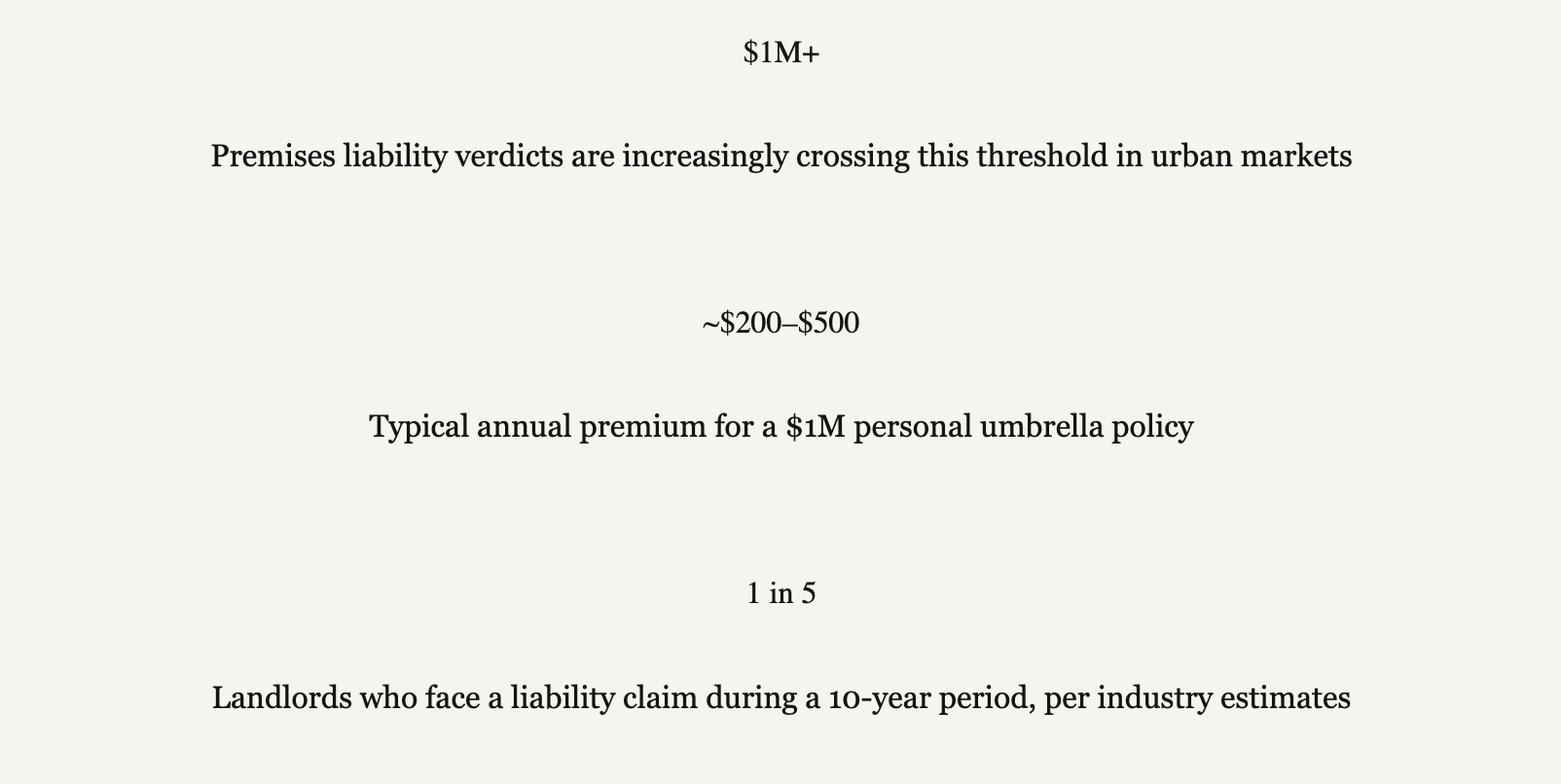
The median landlord liability verdict in a premises injury case has climbed substantially over the past decade. In several metro markets, seven-figure outcomes are no longer the exception — they're a planning assumption.
Personal vs. commercial umbrella: knowing the difference
There are two umbrella products, and they serve different functions. A personal umbrella layers over personal auto and homeowners policies — it's ideal for individual investors whose exposure is in their own name. A commercial umbrella sits above business policies and is the right tool when properties are held in LLCs, partnerships, or other commercial entities.
Many sophisticated investors need both: a personal umbrella to protect their individual exposure (personal vehicle, primary residence, personal liability) and a commercial umbrella to protect their business entities and investment portfolio. The policies don't overlap — they each extend their respective coverage towers.
Properties held in LLCs → commercial umbrella required
Multiple properties in same LLC → one umbrella can often cover all
Properties in your personal name → personal umbrella can help
Mixed portfolio → likely need both umbrella layers
Active construction or renovation underway → verify umbrella extends or add Builder's Risk
What umbrella policies typically don't cover
Umbrella coverage is broad, but not unlimited. Understanding the exclusions is just as important as knowing what's included. Most umbrella policies exclude intentional acts, professional liability (errors and omissions), employment practices claims, and pollution events. Some carriers also exclude certain dog breeds or trampolines on premises — conditions that may already be listed as exclusions on the underlying landlord policy.
For investors with employees or contractors, an Employment Practices Liability (EPLI) endorsement is a separate line worth discussing. Umbrella policies don't typically respond to wrongful termination or harassment claims — those require their own coverage layer.
The right limits for a growing portfolio
A common starting point is $1 million in umbrella coverage above $300,000 underlying limits, giving total liability protection of $1.3 million. For a single-unit investor, that may be sufficient. For a portfolio owner with multiple properties, LLCs, and meaningful personal assets, the calculus changes.
A general rule used in risk planning: your umbrella limits should approximate your net worth. If your portfolio has grown to $3–5 million in equity value, your liability ceiling should be in that range as well. Many investors underinsure here — they add properties without revisiting the insurance tower above them.
Umbrella premiums are among the most efficient uses of insurance budget in a real estate portfolio. Each additional million in coverage typically costs far less than the first — making higher limits a value-add, not a luxury.
When to have this conversation with your broker
If you haven't reviewed your umbrella coverage in the past two years — or haven't had the conversation at all — now is the right time. Trigger points include any property acquisition, an LLC restructuring, a significant increase in portfolio value, or a change in your personal net worth. Your insurance tower should grow with your portfolio, not lag behind it.
At Zhou Agency, we work with real estate investors across Illinois and the Midwest to design layered coverage programs that account for the full picture — not just the individual policies. That means reviewing what's beneath the umbrella and making sure the underlying policies are structured to properly trigger the umbrella when it matters most.